
Wood, stone, metal, and regional inputs
Gathered or purchased materials could fund foundations, walls, repairs, tools, production buildings, and recurring maintenance.

Chapter 08
Territory would be an operated game system: qualifying groups conquer a map cell, construct a limited settlement, supply it with currency and resources, configure approved local fees, and keep its protection alive—or expose it to takeover.
Conquest is a territory operation
The intended first claim requires at least four qualifying clan members in the target area at the same time. Clan membership provides eligibility; the territory service validates and executes the claim.
A claimed cell would not be an NFT, deed, land token, or legal right over the corresponding real-world location.
The complete operating model
The map cell, totem reserve, protection state, buildings, service operators, resource storage, local fee policy, and siege exposure would be linked—but separately auditable—game systems.
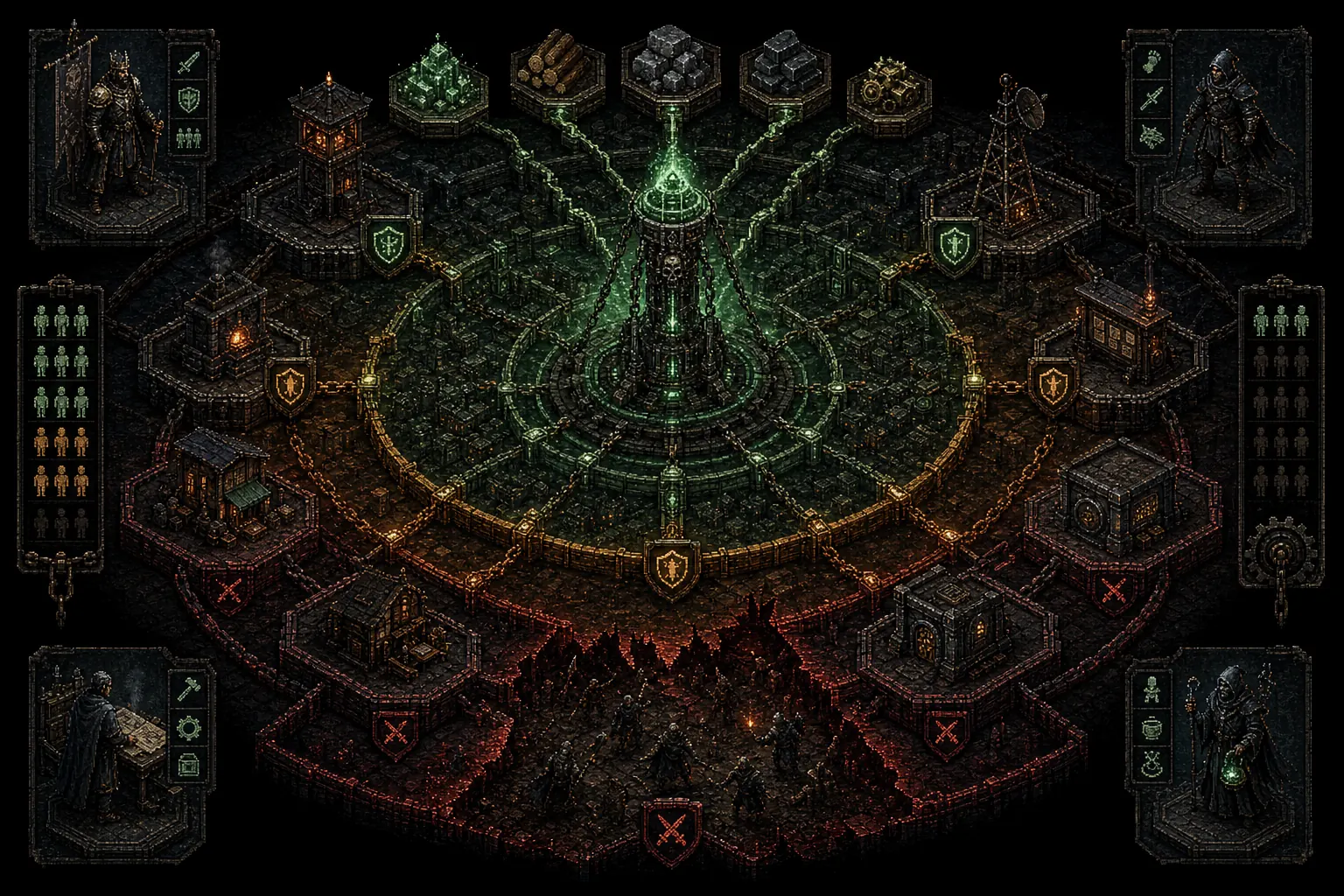
Settlement resource economy
Territory should create demand for gatherers, traders, builders, crafters, guards, and service operators. A settlement would not generate unlimited value merely because a clan holds its map cell.
Gathered or purchased materials could fund foundations, walls, repairs, tools, production buildings, and recurring maintenance.
Architectural parts, mechanisms, fortifications, tools, and tier-specific components could require trained players rather than raw stacks alone.
Totem upkeep, construction, upgrades, staffing, licences, and approved settlement actions could consume NFTerra currency alongside material inputs.
Construction skill, assigned operators, active membership, repairs, guard coverage, and service availability could determine whether infrastructure functions.
Gather, trade, commission, or recover materials and currency through ordinary game activity.
Deposit approved inputs into settlement storage under explicit custody and withdrawal permissions.
Consume materials, currency, specialist work, and available capacity to place or upgrade a building.
Assign a qualified operator, stock inputs, pay recurring costs, and expose the service to eligible users.
Approved service fees could settle to the configured settlement treasury and operator shares.
Use revenue and new supply for upkeep, repair, defence, expansion, or member-approved payouts.
Every active building could consume construction capacity, materials, recurring upkeep, and an assigned operator. Membership and leadership might expand capacity, but no settlement could activate every service without trade-offs.
Player-managed storefronts could expose approved listings to nearby customers, including bounded offline operation.
A managed vault could increase capacity or protect selected items, creating explicit custody, access, takeover, and recovery obligations.
A maintained social building could provide bounded rest, recovery, experience, or production benefits to eligible nearby players.
Crafted fortifications and hired NPC protection could defend structures while owners are offline, limited by skills and upkeep.
Terrain-appropriate gathering and production stations could improve access or efficiency only while staffed, supplied, and protected.
Communication buildings could extend recruitment, contracts, notices, or broadcasts beyond ordinary proximity limits.
The board suggests roughly one managed building per active member, modified by leadership and tier. A small settlement might choose trade and storage while sacrificing defence or production. The final formula remains open.
Operating a successful town
A settlement may outgrow one leader's permissions and personal wallet. Planned DAO modules could give members explicit control over the resources and decisions needed to keep it alive.
Members may govern budgets, contracts, upkeep, and approved fees. Conquest, construction validity, protection, siege, and control remain authoritative server decisions; land control is not an NFT.
Members could contribute under explicit rights, reserve totem upkeep, approve repair and defence spending, and audit distributions.
Builders, suppliers, guards, and service operators could accept milestone agreements backed by materials and currency in escrow.
Eligible members could decide construction order, storage rules, operators, service access, and fee policy inside server-defined limits.
The organization could hold eligible currency, materials, and NFTs collectively or through explicit member shares without tokenizing territory.
Local taxes and service fees
“Tax” would mean a disclosed in-game levy or service charge configured through the settlement—not a real-world tax, unrestricted wallet seizure, or fee on unrelated play.
Protection depends on upkeep
A settlement that expands faster than its economy can sustain would expose its own frontier. Fueling a totem would maintain game protection; it would never make the land permanently invulnerable.
Strong reserve, full working protection, and normal service operation.
Protected, but the settlement has a visible need to replenish its reserve.
Warning state with reduced resilience, higher exposure, or siege disadvantages.
Protection fails; buildings, services, storage, and control become vulnerable under takeover rules.
The cap is intended to require recurring attention without demanding constant feeding. The exact cap, grace period, minimum interval, and contribution permissions remain open.
Settlement progression
Higher tiers could unlock more buildings, services, defence, capacity, and economic influence while increasing upkeep, coordination demands, and attack value.
The role-level gates below—20, 40, 60, and 80—are working values intended to show the progression shape.
| Tier | Working role gate | Design intent |
|---|---|---|
| Outpost | 20 | A limited first claim with a totem, basic storage, and one or two initial services. |
| Settlement | 40 | More service buildings, production support, stronger protection, and local trade activity. |
| Stronghold | 60 | Serious defence, specialist infrastructure, wider capacity, and strategic resource value. |
| Citadel | 80 | A rare endgame holding with high upkeep, coordination demands, and siege importance. |
Siege, loss, and takeover
Territory is intended to create vulnerability and conflict, not permanent ownership. Personal inventory remains separate from assets deliberately placed into settlement custody.
The totem would stop protecting the cell and its structures after the configured warnings and grace period.
The territory record would lose its authorized group. Buildings, shared storage, contracts, and fees would enter disclosed wind-down and vulnerability rules.
Another eligible group could attack, capture, damage, salvage, or reclaim vulnerable territory through scheduled and server-controlled gameplay.
Capture, destruction, salvage, customer-property recovery, operator payouts, and personal storage protections are unresolved and require clear rules before any settlement economy can launch.
Connect people, governance, and place
Review the guilds that create persistent membership, or the DAO systems that coordinate shared assets, contracts, escrow, rights, and member decisions.