
Known level. Hidden potential.
A dagger, sword, axe, bow, shield, tool, or armour base would show its server-assigned item level before trade or minting. It would have a unique game record and origin, but would not yet be usable equipment or an NFT.

Chapter 03
Equipment dropped by mobs would arrive as sealed, unidentified loot. Minting with NFTerra currency and the required inputs would roll its final properties and create the usable NFT exactly once. Consumables, arrows, materials, and quest items keep their normal inventory rules.
Two fundamentally different asset states
The proposed system distinguishes a sealed game-ledger asset from the final NFT. Both could be traded, but they would carry different information, utility, and canonical ownership.
A dagger, sword, axe, bow, shield, tool, or armour base would show its server-assigned item level before trade or minting. It would have a unique game record and origin, but would not yet be usable equipment or an NFT.
The owner would select a specialist, materials, catalysts, tools, and workstation, review the risk, then authorize one versioned generation attempt.
On success, the result would receive final statistics, affixes, appearance, procedural name, token identity, minter attribution, and an immutable genesis record. It remains an actual NFTerra game item, usable and tradeable inside the game, with no external NFT withdrawal.
A failed attempt would create no NFT and could destroy the sealed base and disclosed item inputs. Any charged currency returns to Yasa's project treasury for later approved circulation; the tokens are not destroyed. The disclosed risk is intended to make skilled specialists economically meaningful.
The proposed mint transaction
Every irreversible step would need a visible authorization, idempotent execution, and complete reconciliation across the game and chain layers.
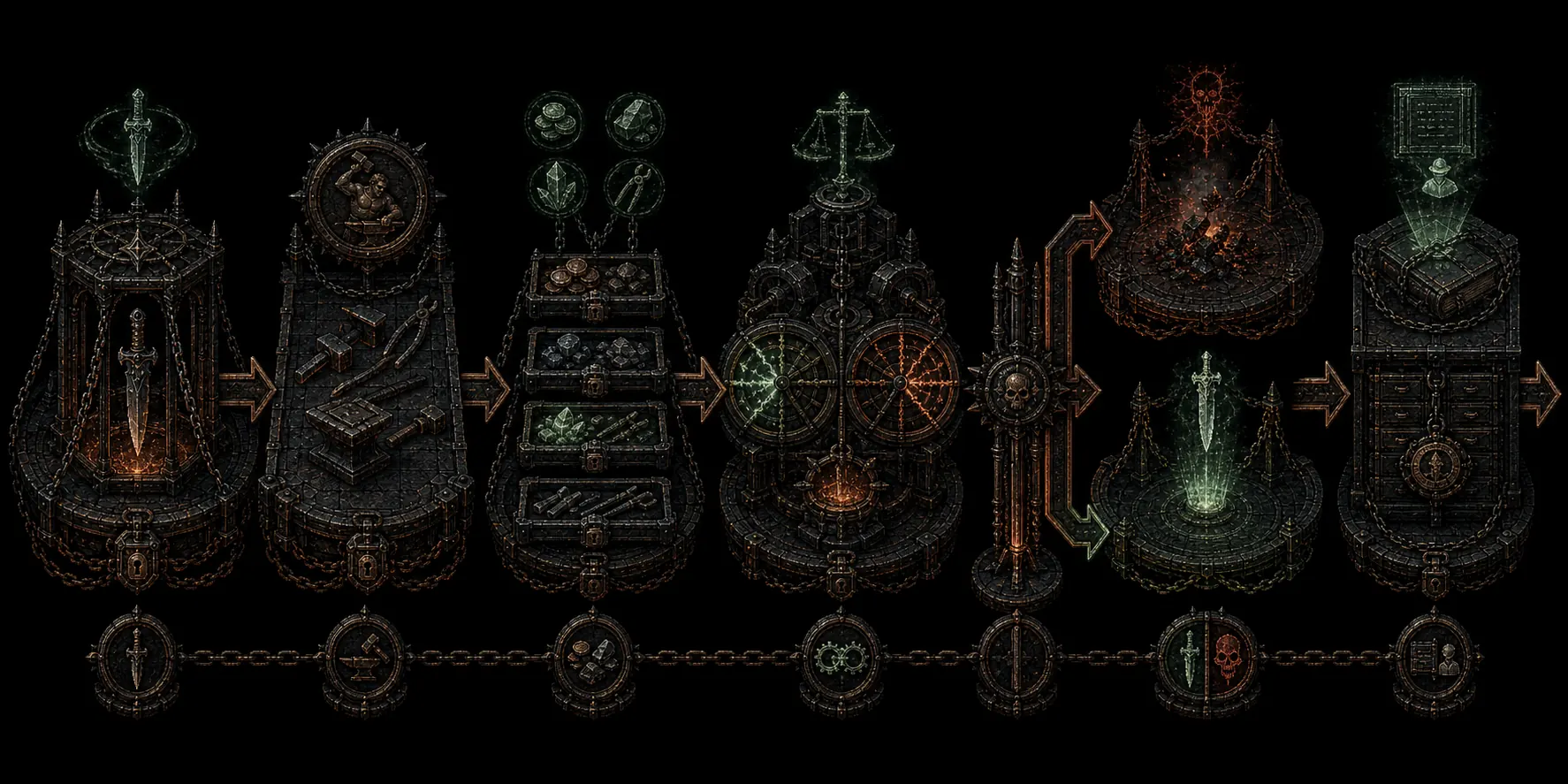
Select the sealed base, specialist, committed materials, catalysts, tool, and workstation.
Show costs, estimated success range, destructive inputs, and versioned rule set before consent.
Lock the base and payment without forcing the owner to hand unrestricted custody to the specialist.
Bind minter, inputs, rules, and cryptographic entropy so the result cannot be silently rerolled.
Apply the deterministic generation rules once and record either catastrophic failure or successful genesis.
Confirm inventory, consumed inputs, fees, NFT ownership, metadata, escrow, and public records agree.
Random, but not arbitrary
Every sealed base has an item level. An expert can improve the outcome within that base's limits, but cannot turn low-level loot into high-level equipment simply by minting it. Trading preserves the base level.
| Input | Planned influence |
|---|---|
| Default base | Equipment family, compatible properties, damage or defence profile, socket potential, and visual silhouette. |
| Base item level | Visible before buying or minting. It limits eligible templates, quality tiers, and statistics, and is retained by the minted item. |
| Origin | Regional, encounter, quest-reward, event, boss, or partner-location provenance and eligible theme tables. |
| Minter | Character level and relevant production skills influence quality within the base's limits. Specialization, tools, and other approved modifiers are frozen for the attempt; skill never guarantees a perfect result. |
| Inputs | Materials, catalysts, runes, tools, workstation quality, and other disclosed modifiers. |
| Rules + entropy | Versioned balance rules and committed randomness that produce one auditable result. |
A player-service economy
Each character has only 100 total points across every skill. A master minter's concentration therefore excludes other masteries and creates genuine demand for trusted services.
Could influence eligible affixes, quality bands, success range, durability, and specialist equipment families.
Would be a separate operation with its own skill gates, materials, risk, mutations, and appended provenance.
Could improve specialist infrastructure, create precision tools, or support sockets and complex production chains.
Verified service history, success distribution, specialties, disputes, and fees could help owners choose a provider.
Players could buy currency, bases, materials, tools, and specialist services, but no purchase can expand the same 100-point total.
Genesis remains permanent
A successful mint would create the immutable origin record. Later operations could change current state while preserving how the item began.
Durability work could consume materials and record the specialist responsible.
New magical effects could carry their own success, mutation, and failure model.
Major reconstruction could alter statistics or appearance without erasing genesis.
Socketing could open new build options under a separate skill and material path.
Tier or quality changes could require rare inputs, mastery, and disclosed risk.
Every accepted operation would add a dated actor, method, input, and rules reference.
The planned randomized mint system has a specific Android commercial-release gate: Google Play's ordinary game policy does not permit taking monetary value for a chance at an NFT of unknown value. The permitted product and distribution route must be resolved before real-value minting. The current work remains a valueless local prototype.
Read Google Play's blockchain policyOn iOS, Apple's rules restrict NFT ownership unlocking app functionality, so usable NFT equipment also requires a permitted release route. Android/iOS cross-play is a game requirement; store approval remains a separate gate.
Read Apple's App Review GuidelinesNext chapter
See how the planned currency, marketplace, exchange ledgers, public receipts, and progression boundary would connect players.