
1 token
1,000 Copper

Chapter 04
NFTerra's planned cryptocurrency would connect minting, crafting, services, marketplace registration, item trade, and territory upkeep. The purpose is to make the currency useful inside the game—not to promise price appreciation.
One currency throughout the game
One Gold is one NFTerra token. Ten Silver, one hundred Bronze, or one thousand Copper have exactly the same value. The maximum supply includes both treasury holdings and tokens in circulation.
1,000 Copper
100 Copper
10 Copper
The smallest supported unit
The intended economy includes real-money purchases, mob drops, daily rewards, project gifts, and player trade. Distribution draws from funded reserves within the cap. Current development focuses on backend systems and exact accounting; reward rates and game content come later.
Players would sell tokens through supported external markets and fiat providers. NFTerra does not promise direct cash redemption, liquidity, or a market price.
The proposed settlement currency
The currency is intended to move because players need useful actions, inputs, and services—not because the website claims it will rise in value.
NFTerra's project treasury would hold the project allocation within the one-billion-token ceiling. Currency paid to the game for minting, repairs, registration, and other system charges would return to this Yasa-owned wallet. Yasa could sell those same tokens again through approved in-game and external channels. The tokens are recycled, not destroyed; total supply does not increase.
Player trade payments go to the seller or specialist. Separate trade fees return to the project treasury and depend on verified trading or merchant skill. The price and fee are shown before confirmation and remain fixed through settlement. Exact rates, discounts, and payment routes are still being designed.
Local development now tests whole sealed-base and ordinary-stack sales between two inventories, using valueless balances. Return sales preserve item identity and level. Frozen merchant-skill fees pay the treasury, consideration pays the seller, and retries cannot charge twice. Received items remain locked until a clearly marked local receipt simulation completes. The public marketplace, token sales and actual public settlement remain planned.
Currency could buy equipment, materials, services, access fees, and bounded experience acceleration. No purchase can add a 101st point or a second character to the device.
Fees, bases, materials, catalysts, tools, and specialist services could all require currency.
Later repair, enchanting, upgrading, socketing, and reforging could create recurring sinks.
Settlement totems would consume currency and resources to maintain temporary protection.
A progression gate and registration payment are the current working design for global access.
Minting, repair, construction, and other specialist work—including qualified skill reallocation—could be priced freely by the players providing them.
Additional sinks could support events, tools, storage, transport, or other balanced gameplay systems.

Why finite skill matters economically
No character can fit gathering, production, combat, building, and every service into the same 100-point budget. That constraint turns mastery into player-supplied work.
Sources, circulation, and sinks
The currency, ordinary resources, sealed loot, NFTs, services, organizations, settlement systems, and external markets would connect through different authorities but one reconciled economic event model.
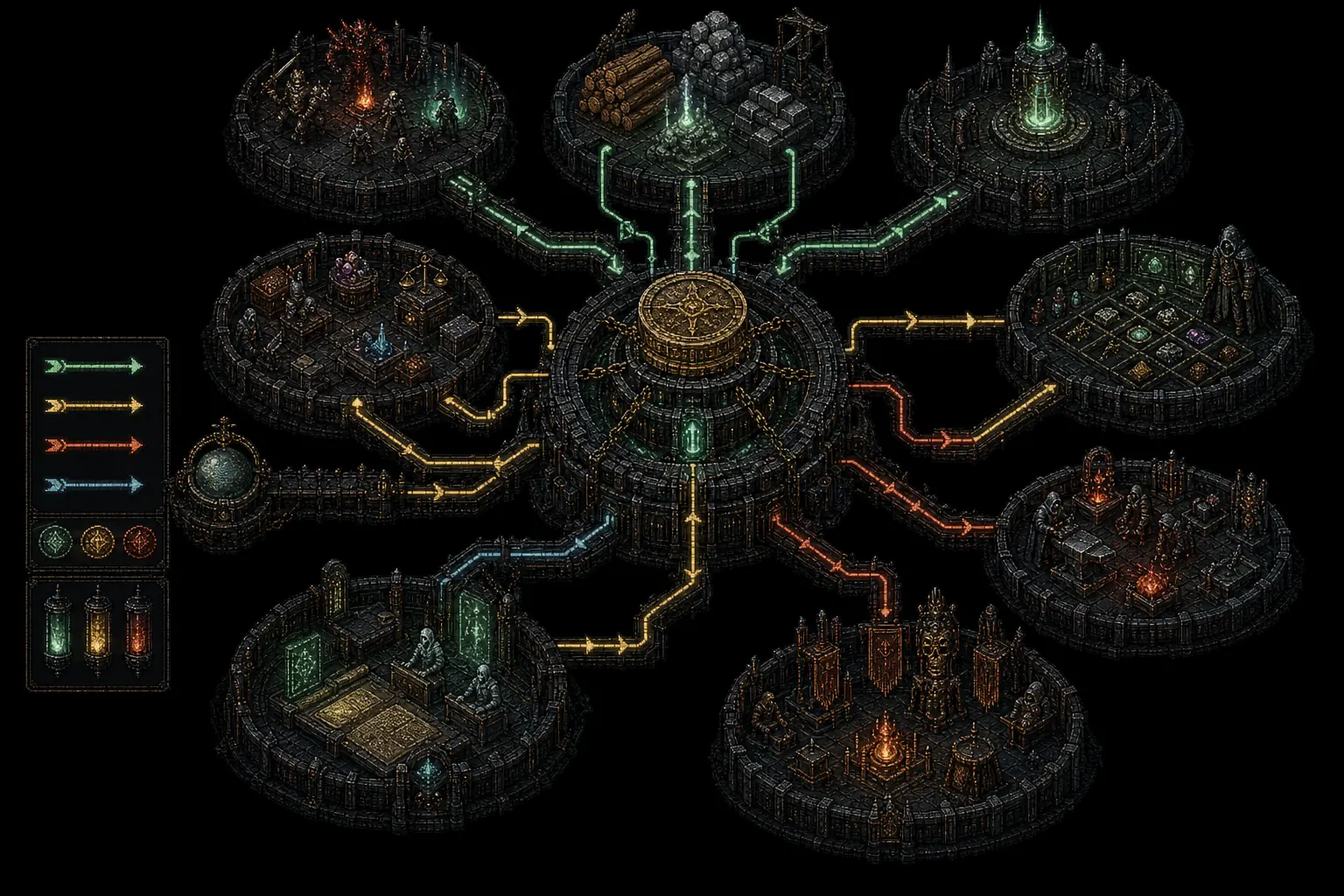
The unified player marketplace
The proposed market would present eligible game-ledger items, minted NFTs, and services together while settling each through its canonical authority.
| Market asset | What a buyer receives | Canonical authority | Trade condition |
|---|---|---|---|
| Sealed item base | An unidentified, unusable base with disclosed family and origin information plus hidden mint potential. | Authoritative game item ledger | Tradeable before minting; temporarily lockable during listing or escrow. |
| Minted relic | A usable unique game item with final name, appearance, statistics, token identity, and provenance. | Supported NFT contract plus reconciled game availability | Tradeable inside NFTerra when eligible, owned, approved, and unlocked. External NFT transfers are blocked by the contract. |
| Ordinary item or materials | Consumables, resources, catalysts, runes, tools, and other approved game inventory. | Authoritative game item ledger | Tradeable by default unless temporarily locked. |
| Specialist service | A defined work order such as minting or repair without transferring unrestricted custody to the provider. | Service escrow, game rules, and relevant asset rail | Inputs and payment settle only after the agreed service outcome. |
| Quest item | Nothing; it represents private quest progress rather than a market asset. | Private quest and progression ledger | Never listable, giftable, exportable, mintable, or wrappable to bypass binding. |
Example economic path
Every step represents intended design. No dagger, marketplace, currency, or NFT exists as a live product today.
The principles are valuable, but the exact death-loss rules conflict on the board. Minted items stay inside NFTerra; damage, destruction, theft, and recovery still require explicit game rules, contract authority, and consent.
Forests, rocky areas, mountains, and other validated terrain could enable wood, stone, metal, and related gathering with the correct equipped tools.
Settlement banks or other storage services could protect selected inventory, increase capacity, and create a trusted local service business.
Death could risk carried game-ledger items through damage, destruction, theft, or recovery windows; exact protected slots and NFT rules remain open.
Player-managed shops in operated settlements could continue selling approved listings while the owner is offline.
Settlement operators could charge transparent, bounded fees for storage, production, trade, communication, defence, or other maintained infrastructure.
Construction, upgrading, crafting, and totem upkeep could remove ordinary resources from circulation without making every stack an NFT.
Public accountability without exposing private play
NFTerra-supported exchanges are intended to maintain an append-only exchange subledger and contribute a public settlement record or cryptographic commitment.
The responsible venue would record authorization, matching, price, fees, locks, settlement, failures, disputes, and corrections.
NFT sales could use on-chain transfers. Non-NFT trades could publish receipts or commitments without converting the item into an NFT.
Exact location, real identity, private quest state, device identifiers, and hidden loot outcomes would stay out of public trade data.
Token movement, item ownership, NFT transfer, exchange records, fees, and player inventory would have to reconcile before a trade is marked complete. Retries must return the original result rather than execute a duplicate.
Access and market integrity
Level 5 and a one-time currency registration fee are the current working thresholds, not final rules.
Eligibility could also depend on age, jurisdiction, account standing, wallet status, sanctions and fraud controls, marketplace terms, and regional availability.
The transferable token purchase flow and randomized NFT mint design require specific store and provider review before commercial release. No payment or cash-out service is active.
Next chapter
Review the proposed separation between the map client, authoritative game world, mint and exchange bridge, and public ownership rails.