
Browse character races
Human, Automaton, Atlantean, Felinor, Barbearian, and Otterfolk have dedicated design pages. Their gameplay bonuses remain unapproved.

Chapter 02
Each mobile device would support one character and one inventory wallet. That character has 100 skill points total across combat, gathering, production, magic, and utility—forcing every build to choose what it will master.
Two separate creation choices
Neither choice replaces the earned 100-point specialization that follows.
Human, Automaton, Atlantean, Felinor, Barbearian, and Otterfolk have dedicated design pages. Their gameplay bonuses remain unapproved.
Archer, Wizard, Fighter, Builder, and Harvester only determine profession-themed starting items. They grant no skills or bonuses.
Valid actions train their correlating skills. The resulting allocation—not race or starting class—creates the character's actual profession.
One finite character build
100 is the maximum sum across the entire skill roster—not the maximum granted separately to every skill.
| Example build | Woodcutting | Cooking | Other skills | Total | Result |
|---|---|---|---|---|---|
| Two-skill hybrid | 50 | 50 | 0 | 100 | Valid · cap reached |
| Master woodcutter | 100 | 0 | 0 | 100 | Valid · full mastery |
| Broad specialist | 40 | 30 | 30 | 100 | Valid · cap reached |
| Double master | 100 | 100 | 0 | 200 | Impossible |
Valid woodcutting raises Woodcutting; valid cooking raises Cooking. The authoritative server awards progress and enforces the shared total.
The character's inventory carries currency, NFT equipment, sealed bases, and ordinary items as one device-associated wallet experience.
Every point committed to one discipline is unavailable to the others, so no character can supply every product or service alone.

Identity is a beginning
Archer, Wizard, Fighter, Builder, and Harvester tell the game which current starter items to place in the opening inventory. They do not grant skills, experience, statistics, bonuses, affinities, abilities, or locks.
A Builder receives a construction-themed tool but no Construction skill. A Fighter receives combat equipment but no Attack or Defence progress. Either character can change direction by using other equipment and training other skills.
Candidate disciplines include attack, defence, agility, ranged combat, magic, health, and later weapon specializations.
Gathering, farming, mining, foraging, and other location-sensitive skills could supply the production economy.
Blacksmithing, crafting, cooking, enchanting, construction, and related disciplines could support players, organizations, and settlements.
Leadership, exploration, summoning, necromancy, engineering, and other utility systems remain candidates for later design.
The proposed progression shape
The diagram is explanatory concept art. The 100-point shared cap is confirmed; the exact skill roster and gain curve are still being designed.
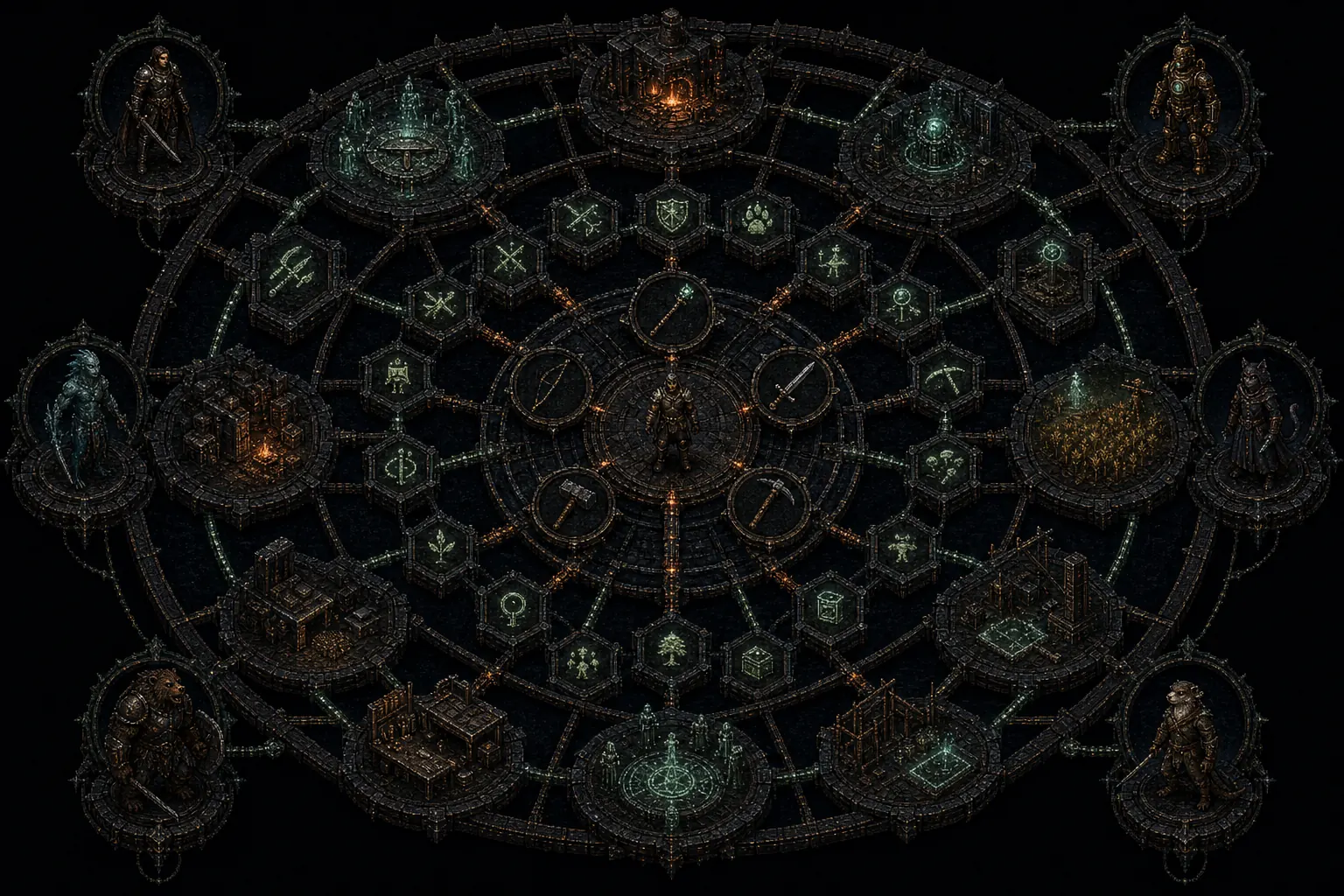
Their names and legacy themes are documented as world-building direction. Statistics, skill modifiers, perks, resistances, and other gameplay bonuses remain open until separately approved.
Adaptable survivors and organizers associated with broad development and group strength.
A towering copper mining construct whose industrial tools were repurposed for survival and war.
An aquatic exile dependent on prototype life-support armour and drawn toward forbidden knowledge.
A feline occult lineage associated with stealth, fear, and dangerous dark-magic traditions.
A massive self-aware bear warrior culture built around endurance, force, and survival.
An agile, observant scavenger tradition associated with negotiation and opportunistic play.
Skills create interdependence
The 100-point total makes universal mastery mathematically impossible on one device-bound character. Economic power comes from networks of specialists.
Blacksmiths, enchanters, engineers, and other producers could perform escrowed work for owners.
Biome-linked wood, stone, metal, plants, and rare catalysts could move through multiple professions before use.
Leadership, combat, construction, and totem disciplines could gate conquest, building, upkeep, and service capacity.
Completed jobs, outcomes, disputes, specialties, and reliability could help players choose service providers.
As one supporting service mechanic, high-level mages could free, assign, or reroll existing allocations and charge any price another player agrees to pay.
Currency, equipment, inputs, and enhancers may be purchased. Completed skill levels and progressed characters may not.
Next chapter
See how sealed item bases, specialist skill, committed materials, catastrophic risk, and auditable randomness would produce unique NFT relics.